

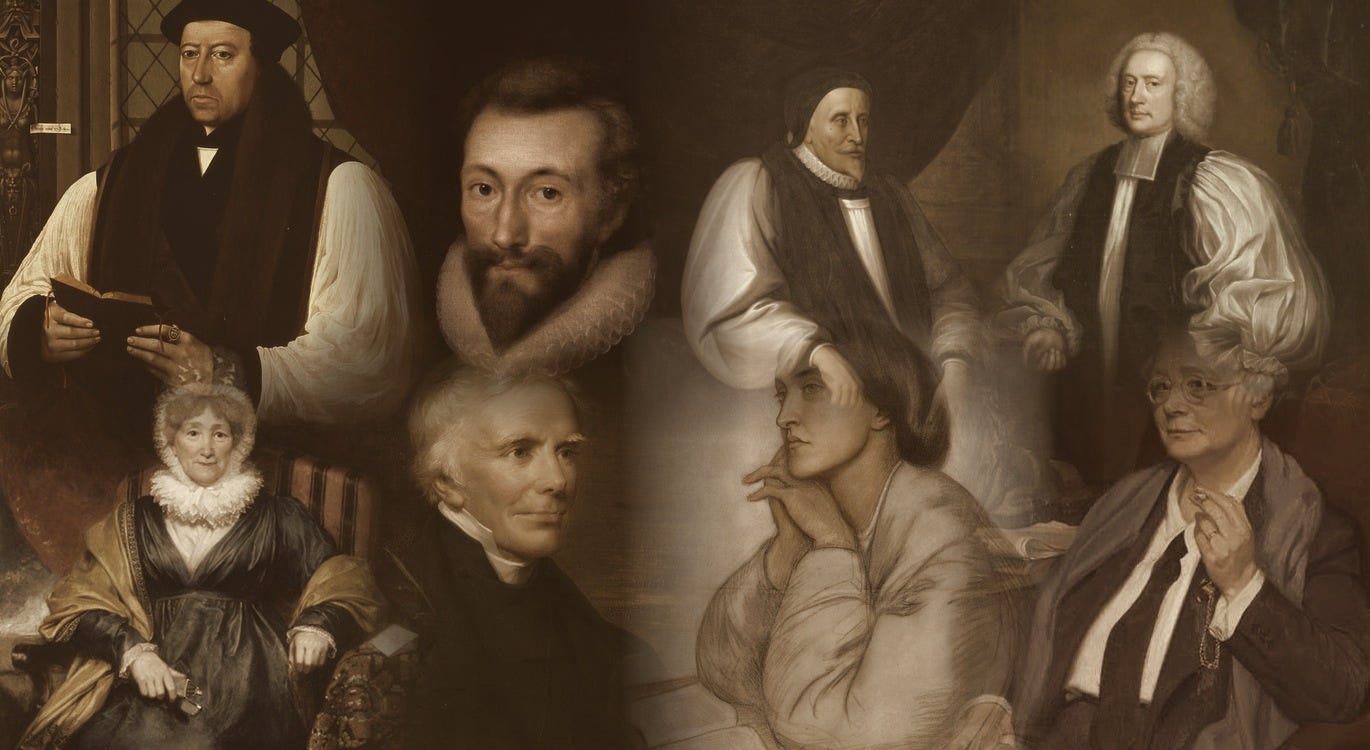
The other day, while searching through a folder of saved documents, I came across some of the material I produced for my students when I was teaching Anglicanism at Cranmer Hall in Durham — a role I took on not long after beginning my doctorate in 2008. I knew little about the contemporary culture of the Church of England, and even less about the particular species of Anglican Evangelicalism represented by many of my students. What I did have was an abiding love of Anglicanism.
I wanted my students to appreciate that Anglicanism isn’t simply a set of arrangements for running parish churches, nor even a compromise between Catholics and Protestants that had somehow survived into the twenty-first century. I wanted them to see a tradition with its own intellectual and spiritual integrity, populated by theologians and preachers, poets and mystics, eccentrics and saints. I wanted them to meet these people—to discover that the church they had inherited had produced some remarkable Christians, and that its inheritance was considerably richer than most of them realised.
Looking back, I can see something slightly comic about this. Here was an American who had only just arrived in England, trying to persuade British ordinands, preparing for ministry in contemporary Britain, to rediscover their own ecclesial heritage. I was, in effect, the stranger at the dinner table telling family stories back to its members.
But perhaps strangers sometimes notice what families have stopped seeing.
I took a two-pronged approach. The first was simply to teach my students something about the various Anglican traditions: how they emerged, developed, and collided with one another. The module didn’t leave much room for extensive reading of primary sources, but I tried, at least, to give them glimpses of the people behind the labels. Anglicanism can look rather different when you stop talking about “Evangelicalism,” “Catholicism,” “Liberalism” and “Latitudinarianism” and start talking about Latimer, Andrewes, Taylor, Wesley, Keble, Maurice or Temple.
The second approach was more ambitious, and much more enjoyable. I started an Anglican Reading Group, open to anyone who was interested. Once a month, over glasses of wine, we would gather in the evening to read a short work by an Anglican worthy. We began with Hugh Latimer’s Sermon of the Plough.
At first we met at St John’s College. Later we moved into the grand living room of the Van Mildert Professor’s residence, then occupied by the lovely Mark McIntosh, who would later tragically die far too young.
The reading group never attracted as many ordinands as I’d hoped. This is one of the small humiliations of academic life: you discover that the people you’ve invited to delight in great ideas would rather be somewhere else. Still, we always had a good mixture of students, clergy, and faculty drawn from a range of disciplines across the University and from local churches. It worked so well that the reading group outlasted my departure by several years.
Some of my fondest memories of Durham are of those evenings. We would sit in comfortable chairs with portraits of past Van Mildert professors gazing down at us and discover, sometimes to our surprise, that people who had been dead for a century or two could still say something to us now. And every now and then a passage would stop us in our tracks. I still recall fondly a time when Prof. McIntosh seemed to vanish into his own world as he contemplated aloud a passage from Lancelot Andrewes and being struck by the richness of two great minds, separated by more than three centuries, in resonance.
That, I think, is what a tradition is supposed to do. A tradition isn’t merely a collection of things our predecessors happened to believe. It’s an inheritance of arguments, prayers, habits, failures, insights and discoveries, handed from one generation to another for the rather dangerous purpose of allowing the next generation to make use of it. The point of inheriting a tradition isn’t to preserve it in amber. It’s to have something substantial enough to argue with and learn from.
Among those saved documents is a list of key Anglican writers that I composed for my ordinands. Though I’d forgotten about it, once I looked at it again, I remembered sitting in a Durham coffee shop and assembling it.
I thought it might be fun to offer the list to my readers. It’s not intended to be comprehensive, partly because I seem arbitrarily to cut it off around 1980. But, comprehensiveness would rather defeat the point. The Anglican tradition is too sprawling, contradictory and fertile to fit comfortably on a single bookshelf.
Any list like this is an act of judgement, and therefore an invitation to disagreement. There are writers here whom some Anglicans will regard as obvious choices and others who will wonder how on earth they made the cut. There are people I love who are absent. There are people I definitely don’t love who are here because they help show the breadth of the tradition.
Finally, I offer this quite deliberately as a list rather than canon. Perhaps there’ll be a work on it you has never read. If so, tolle, lege.
The List
Sixteenth century
Thomas Cranmer (1489–1556) — “Preface”, Book of Common Prayer (1549)
Hugh Latimer (c. 1485–1555) — “Sermon of the Plough” (1548)
John Jewel (1522–1571) — An Apology of the Church of England (1562)
Books of Homilies (1547, 1562–63)
Articles of Religion (1571)
Seventeenth century
Richard Hooker (1554–1600) — Of the Laws of Ecclesiastical Polity
Lancelot Andrewes (1555–1626) — Preces Privatae
John Donne (1573–1631) — Devotions upon Emergent Occasions
George Herbert (1593–1633) — The Temple
Jeremy Taylor (1613–1667) — Holy Living, Holy Dying
Thomas Traherne (1637–1674) — Centuries of Meditations
Eighteenth century
William Law (1686–1761) — A Serious Call to a Devout and Holy Life
Joseph Butler (1692–1752) — The Analogy of Religion
Hannah More (1745–1833) — Practical Piety
Nineteenth century
John Keble (1792–1866) — The Christian Year
John Henry Newman (1801–1890) — Tract XC
F. D. Maurice (1805–1872) — The Kingdom of Christ
Charles Gore, ed. (1853–1932) — Lux Mundi
Christina Rossetti (1830–1894) — The Face of the Deep
Twentieth century (to 1980)
Evelyn Underhill (1875–1941) — Mysticism
William Temple (1881–1944) — Nature, Man and God
Dorothy L. Sayers (1893–1957) — The Mind of the Maker
C. S. Lewis (1898–1963) — Mere Christianity
A. M. Ramsey (1904–1988) — The Gospel and the Catholic Church
J. I. Packer (1926–2020) — Knowing God
What Connects Them
Set these twenty-five writers beside one another and, despite all their disagreements, a family resemblance begins to emerge. It certainly isn’t a shared doctrine—Anglicans have never been especially good at that sort of thing. It’s something more like a shared instinct about how doctrine ought to be held.
The first instinct is an aversion to system-building. Hooker’s great achievement was to make “law” capacious enough to hold Scripture, tradition and reason within a common life rooted in divine laws. Doctrine, in this tradition, is tested by its fit with worship and inherited practice. Theology has to survive contact with the Church.
The second is a conviction that holiness is formed rather than declared, mostly in the ordinary run of days. Law’s Serious Call, Taylor’s Holy Living and Holy Dying, Herbert’s poems about pulleys and floors and windows, Underhill’s patient attention to the discipline of prayer: these are instruments for practising holiness, not treatises on it, on the assumption that the Prayer Book’s own rhythm is itself a kind of theology.
There’s also a high view of reason that normally avoids curdling into rationalism—reason accompanied by tradition and tested within the worshipping community, which is what I hear in Ramsey’s insistence on doing theology on one’s knees. And there’s a marked reticence about certainty wielded as a weapon: the Articles and Homilies were written to comprehend rather than exclude (even if they didn’t feel that way to later generations), and Maurice spent a career resisting the way truth gets distorted once it’s enlisted for a faction. Call this the via media instinct, though I’ve never thought it was mainly about splitting the difference between Rome and Geneva—it’s something more interesting: a settled suspicion of theology whenever theology turns into a weapon.
Finally, there is an incarnational seriousness about matter, an unusual reluctance to let the spiritual float free of bodies, places and things. Herbert keeps returning to the furniture of an actual church, Rossetti to the flesh-and-blood particulars of Revelation’s imagery; Temple went so far as to insist that Christianity is “the most avowedly materialist of all the great religions.” Even the shape of this list makes the argument—sermons, prayers, poems and devotions far more readily than systems, which suggests where Anglican theology has often actually lived: not chiefly in propositions, but in the embodied, communal practices those propositions were meant to serve.
I still think of those Durham evenings often—the wine going round, someone reading Latimer aloud in that grand room while Prof. McIntosh presided with his particular gentleness, each of us delighting in the texts as much as in each other’s company. I hope this list does something of the same work for whoever stumbles on it: not a syllabus to master, but an invitation to sit for an evening with people who knew, long before we did, what it might mean to be formed by a tradition rather than merely to hold opinions about one.
Excellent! I’ve recently returned to Ramsey to transcend current positions that have become reductionist and yet claim their positions as true Anglicanism. I shall by God’s grace return to some of the others while I am still able now turning 80. 😊
Beautiful! Thank you! I'd love to know whom / what would you add from post 1980s-ish Anglicanism. I'm guessing something from Rowan Williams might end up on the list... other thoughts...?