

The World’s Last Night
A Good Friday Meditation on Donne's Sonnet XIII
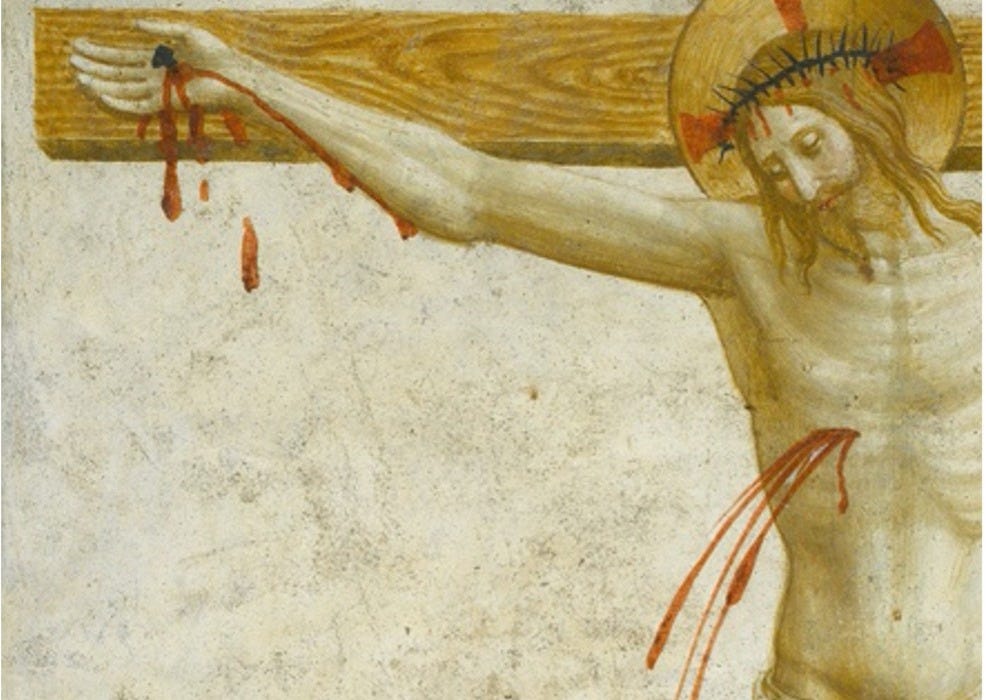
“What if this present were the world’s last night?”
Donne’s poem begins with a stark, unsettling question—one that would’ve struck home for those who stood at the foot of the cross when the sun’s light failed (Luke 23.44–45). For them, it truly must’ve felt as if their world were ending.
We often skip too quickly past this apocalyptic dimension. Our liturgies move with solemn beauty through Good Friday, but we’ve learned the story well enough to know what comes next—we know Easter morning awaits. Donne, however, won’t let us rush. He demands that we sit with the enormity of this moment, as if this night really were the last. As if all hope had fled alongside the disciples.
“Mark in my heart, O soul, where thou dost dwell,
The picture of Christ crucified, and tell
Whether that countenance can thee affright.”
Donne calls us to a visual meditation—not just a mental exercise, but a prayerful imagining. Picture the crucified Christ, he says, and ask your soul whether that face could possibly horrify you. This practice echoes medieval devotional traditions, when believers would dwell long on Christ’s wounds—not out of morbidity, but to know that he suffered with and for them.
This is the heart of the Veneration of the Cross—a ritual movement from imagination to incarnation. We don’t merely reflect on Christ’s wounds; we approach them. We bow before the wood, touch the rough beam where love was nailed, even kiss it tenderly. These are acts of reverence, but also of response. To venerate the cross is to say, “This is what love looks like.” To allow Christ’s suffering face to quiet our fear and kindle our hope.
”Tears in his eyes quench the amazing light,
Blood fills his frowns, which from his pierced head fell.”
Donne’s language turns graphic, but it isn’t gratuitous. He describes the blood not simply to be gruesome but to recall the covenant. From the lamb’s blood in Exodus 12 to the blood of the new covenant in Luke 22 and Hebrews 9, it is always blood that marks the cost of love, the price of life for life.
And here on the cross, blood doesn’t serve as a mark of divine wrath but as the seal of divine mercy. As we kneel before the cross, we’re reminded that this mercy wasn’t abstract—it bled. And still, in mystery, it covers us.
“And can that tongue adjudge thee unto hell,
Which prayed forgiveness for his foes’ fierce spite?”
Here we come to the theological turning point. Donne’s rhetorical question hinges on the absurdity of condemnation flowing from the same mouth that said, “Father, forgive them” (Luke 23.34).
Here, divine justice and divine mercy aren’t in conflict—they’re one. Christ doesn’t suffer in spite of his enemies but for them. And in the Veneration of the Cross, we bring our own enmity, our betrayal, our distance—and find that the cross speaks forgiveness still. We don’t venerate to honour a symbol; we venerate because this tree has become a throne of grace. Our veneration is, therefore, an act of homage, a pledge of faith.
“No, no; but as in my idolatry
I said to all my profane mistresses,
‘Beauty of pity, foulness only is
A sign of rigour’: so I say to thee.”
These lines are deeply Augustinian, echoing his idea of “disordered loves.” Donne confesses that he used to look for beauty in the wrong places—mistaking superficial charm for divine approval. Now, at the cross, he sees rightly. It’s not in splendour but in suffering that God’s love is made manifest.
This is difficult to accept in a culture (and often, a Church) that prizes polish. The cross isn’t elegant. It’s, in a human sense, grotesque. And yet here, in this “foulness”, is the beauty of God’s mercy. And so we bow before it—not in admiration, but in awe.
“To wicked spirits are horrid shapes assigned;
This beauteous form assures a piteous mind.”
Donne concludes with contrast: wicked spirits wear twisted shapes; Christ’s broken body reveals divine pity. This is Christus Victor theology, plain and simple. The cross is rightly understood not as defeat but as triumph, though of a very peculiar kind.
That “piteous mind” of Christ—the self-giving heart of God—is the key to it all. It’s not strength as the world knows it—as our politics increasingly seem to exalt it—but power made perfect in weakness. The cross becomes, through veneration, the lens by which we see all suffering transformed. We don’t run from sorrow. We carry it to the cross, where it meets the sorrow of God and is transfigured.
Of course, the story doesn’t end with Good Friday. We know that. And yet we’re meant to linger here, as Donne lingers with his question: “What if this present were the world’s last night?”
To sit in this possibility isn’t despair; it’s discipleship. The cross doesn’t deny the reality of suffering; it transforms it. As Fyodor Dostoevsky wrote, “All things are atoned for, all things are saved by love.” The cross tells us that even death isn’t the final word.
In the end, Donne’s poem is about wounds that heal. Love that judges not with fire, but with tears. A Saviour whose very silence cries out forgiveness. A broken body that is, somehow, beautiful.
Today, we stand at the foot of the cross—not as observers, but as those whom Christ died to save. In the Veneration of the Cross, we’re invited not just to reflect but to approach. Donne’s meditation calls us to gaze unflinchingly with the eyes of our minds, move reverently with our bodies, to draw near and adore with our hearts.
To kiss the cross is to say: This is where my hope lies. This is love. This is everything.
And then to believe.
A profound, lovely and very moving reflection- thank you Mark
One of my favourites — if I remember the title correctly — is Good Friday Riding Westward, partly because I love the image and feeling that title calls up in me, but also because I often have been driving westward to Penzance (where I am now) on Good Friday.