

The Shape of Love
A Reflection on the Days of Holy Week
I’ll return to Formed for Faithfulness after Easter. This week, I simply offer a brief reflection on Holy Week.
There’s an old temptation to treat Christian faith as an interior affair — a matter of the soul’s private commerce with God, sealed off from the common life of the world. Holy Week doesn’t permit this. From the moment Jesus enters Jerusalem on a donkey to the moment his broken corpse is lowered from a cross between two criminals, everything that happens is irreducibly public, political, and relational. To walk through these days attentively is to find oneself repeatedly asked the same question from different angles: what does it mean to belong to this person, and what does belonging to him make of us?
The triumphal entry & the transformation of power
Consider the donkey. When Jesus enters the holy city on one, he’s not making an ironic gesture of humility. He’s making a claim. Humble mounts were the steeds of Davidic kings; Solomon rode his father’s mule to his own coronation. The prophet Zechariah had promised that Israel’s coming king would enter Jerusalem precisely this way. The crowd spreading cloaks and palm branches knew their coronation liturgy well enough to recognise what they were seeing, or thought they were seeing. The scandal of Palm Sunday isn’t the donkey; it’s that the king arriving on it is a Galilean craftsman with no army, no temple patronage, and a reputation for eating with the wrong people.
What Jesus inaugurates, then, isn’t a rejection of kingship but its transfiguration from within. The entry invites us to ponder a question that the week will go on answering in increasingly difficult ways: what does sovereignty look like when it belongs entirely to God? The long tradition of Israel’s prophetic imagination — the vision of a king who would shatter the weapons of war and speak peace to the nations — is being given flesh and bone and a borrowed ass. Something is arriving that the world’s arrangements haven’t prepared for and can’t easily accommodate. The palm branches are waving, and no one present really understands who they’re welcoming in.
The temple & the upper room
A kind of moral darkness begins to gather during the days that follow. You can feel that time’s running short. The hour is almost at hand. In the temple precincts, Jesus exposes the contradictions of those who have turned the house of prayer into an instrument of extraction — the same claim as the royal entry, now made with overturned tables.
What are the people of God for?
The question hangs in the dusty air of the market where Jesus next teaches openly, attentive to whoever approaches: those in genuine confusion, those looking to entrap him, those hovering at the edge. Yet there’s an irony sharpening beneath the scene’s surface. The temple Jesus cleanses and teaches in is already, in some sense, being superseded by his presence within it. He is the place where God and humanity meet. He is the living fulfilment of everything the stones and courts and sacrifices were always pointing toward. The institution is giving way to the person.
Jesus speaks of a vine and branches, Israel’s own familiar self-image that runs through psalms, prophetic books, and temple symbolism. When Jesus says I am the true vine, he reframes where divine life is now rooted and how it’s received. The disciples aren’t being recruited into a new movement; they’re being grafted into the one who is making Israel’s vocation his own. Their life won’t be their own achievement; it will be something received, something to inhabit, something that will sustain them through death itself.
Jesus promises the Spirit who will continue his presence among them. And then, with the night already well advanced, he calls them friends. Not servants. Friends. The one who has been their rabbi will go to his death as their friend.
The foot washing & the grammar of service
Before the discourse, before the meal, Jesus takes a basin and a towel and kneels before his disciples — before all of them, including the one he knows will soon betray him. Peter’s instinct to refuse is only human. Something is being violated here, some necessary structure of roles and dignities. But Jesus insists, and in his insistence there is something deeper than a moral lesson about humility. The foot washing is a disclosure. What we’re being shown in this small lamplit room is what divine power actually looks like when it’s fully itself: not self-assertion but self-gift, not a golden crown but a damp, dirty towel of a crouching slave.
There is perhaps no better preparation for the days ahead than to sit with the image of Jesus on his knees, holding someone’s dusty foot, and then to ask ourselves what this means for everything we think we understand about power and status and love and God.
The grammar of faith this teaches is the constitution of the community that bears Christ’s name. The meal that follows deepens and seals the same logic. This is my body, broken for you. This is my blood, poured out for many. The words interpret the foot washing and anticipate the cross — the whole movement of God toward humanity gathered into bread and cup, handed across a table to friends who don’t yet understand what they’re receiving. Here, at the origin of the Eucharist, an economy of gift is enacted that will stand at the centre of Christian worship ever after: abundance flowing toward need, life offered freely across the boundary of death. Those who receive it are sent — back out into the night, and into the world.
The cross & the solidarity of suffering
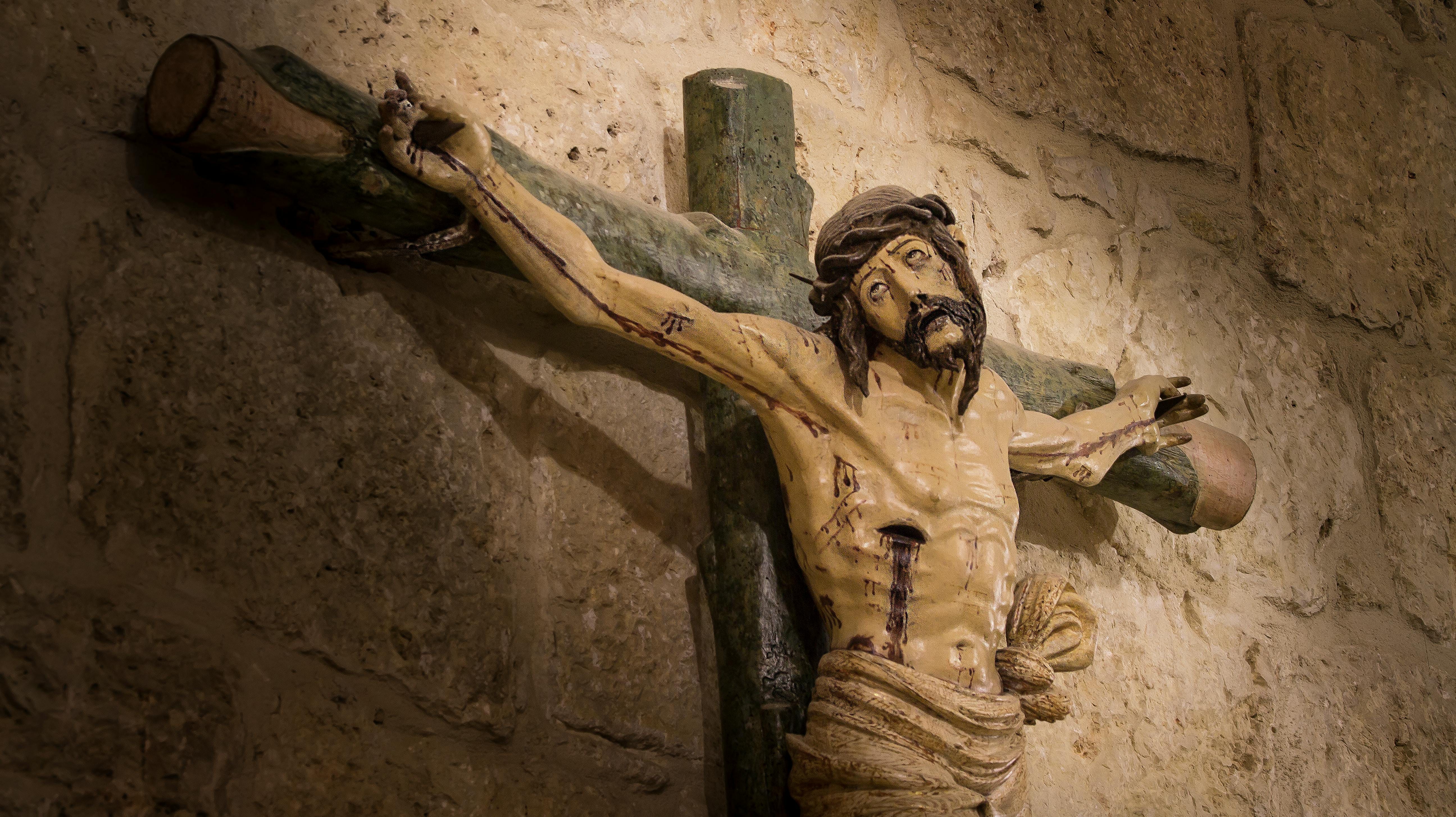
Good Friday arrives at its terrible, irreducible point. Jesus is executed as a political criminal, outside the city walls, in the company of condemned men, abandoned by almost everyone. Hosanna has become crucify him. He dies in public shame, condemned by imperial and religious authority alike, rejected by his own people, forsaken by his friends. The Angel of Death comes to carry off the Paschal Lamb himself. It’s important to tarry here to gaze upon the “man of sorrows.” The resurrection that follows is always the resurrection of this particular crucified man; the glorified body still bears the wounds. The community that is his very Body is constituted by that brokenness, and loses something essential whenever it forgets this.
To stand at the foot of the cross is to be invited into a recognition that doesn’t come easily: that the confluence of forces that put Jesus to death — empire administering violence, popular opinion aroused against the innocent, religion protecting its own authority — isn’t confined to the first century. It recurs. And God, in Christ, is never aloof from it. Christ has entered it; borne it from within. This is perhaps the most difficult thing Holy Week asks us to contemplate: not that God watches human suffering with compassion from a safe distance, but that God has been found in the place of abandonment itself, and that no depth of human diminishment lies beyond the reach of his presence.
The whole shape
Taken together, these days describe a particular shape of love: public and embodied, truth-telling and self-emptying, sacrificial and communal. The Gospel evokes the community that bears that love, and the community can’t remain in that love without the Gospel. At the heart of both Gospel and Church stands the drama of this week. It’s in these days that we recollect that our Christian identity is always relational, always being shaped in and through the Body of Christ, always oriented toward the concrete other rather than any merely private transaction with the divine.
Holy Week ultimately asks for our attention — our willingness to move deliberately through these days, letting each scene of this strange and terrible drama do its work. The king on the donkey. The overturned tables. The friends around a table, bewildered and beloved. The basin of water. The broken bread. The cross outside the city walls. None of these images yields its full meaning quickly, and none of them leaves us where we were before we encountered it. To walk through Holy Week with genuine attentiveness is already to be changed — to discover, in the shape of these events, what human life in its fullness might become, and to ask ourselves if we’re willing to receive it.