

The Deepest Truth Is Love
A reflection for Trinity Sunday
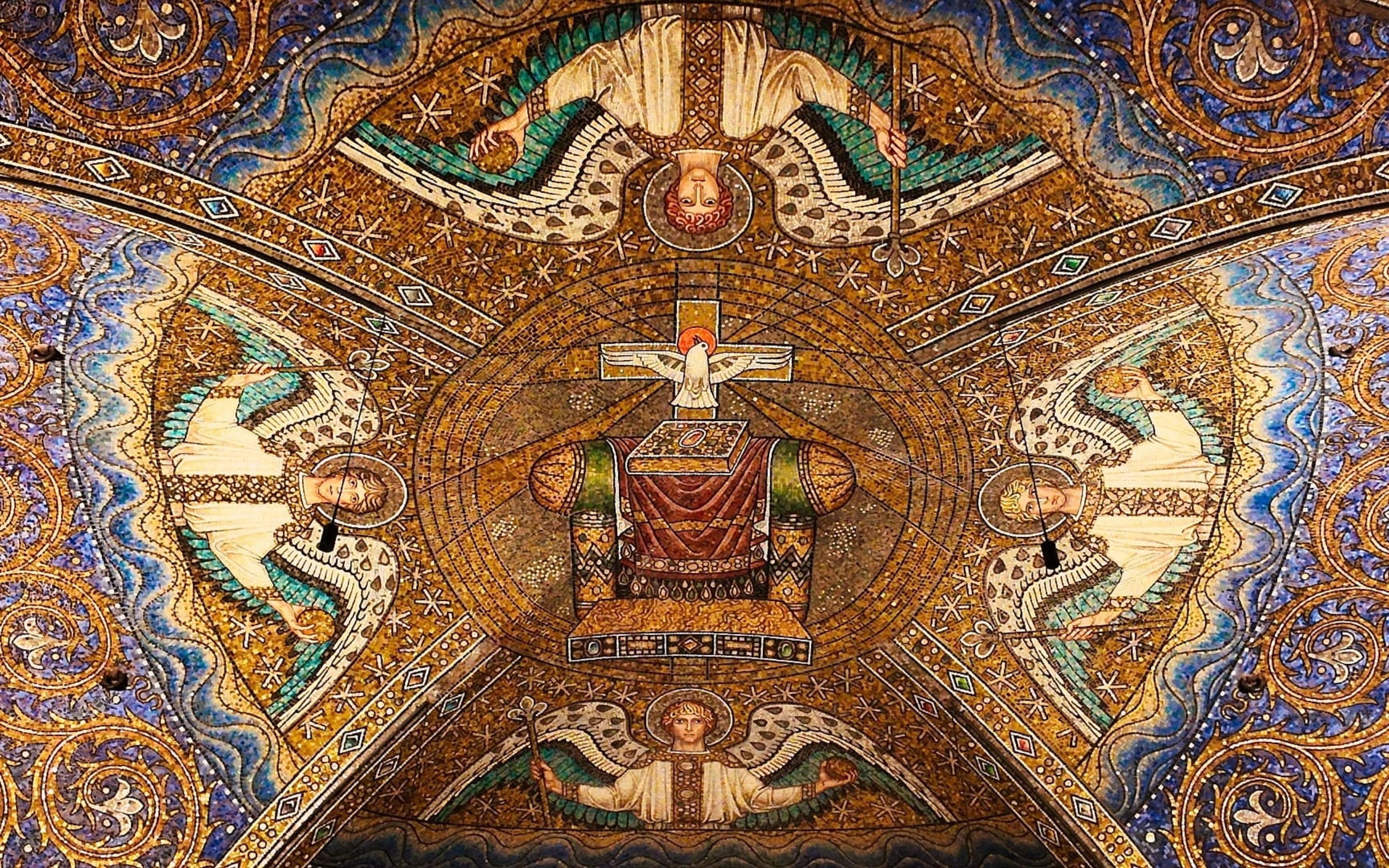
Each year on Trinity Sunday, God is put through the indignity of being compared to water, an egg, or a three-leaf clover. Most people nod politely at these analogies while privately concluding that the Trinity is a kind of theological maths problem: how God can somehow be three and one at the same time.
The Church Fathers weren’t, of course, trying to create a spiritual brain teaser for future generations. The doctrine of the Trinity emerged from a long struggle to speak faithfully about the God revealed in Jesus Christ — and it pressed language to the edge of what language can do. But once Christians began speaking this way about God, it inevitably reshaped how they understood everything else.
The heart of the Christian claim isn’t simply that God exists, but that God isn’t eternal solitude. Before there were galaxies, oceans, or human beings, there is already love: Father, Son, and Holy Spirit in perfect communion.
We catch faint glimpses of this in ordinary life — in deep friendship, in family, in shared meals, even in something like choral music where distinct voices create harmony without losing their distinctness. Such experiences don’t explain the Trinity. But they help illuminate why Christians have long believed that love and communion aren’t accidental features of existence, but reflections, however partial and imperfect, of the deeper reality from which creation comes.
What We Are Made For
Every human being bears the image of our Triune God and possesses, for that reason alone, a worth that no achievement, failure, or circumstance can diminish. But that dignity isn’t fully lived in isolation. Human flourishing is found neither in solitude nor in the erasure of individuality, but in self-giving communion grounded in love. And this vision doesn’t project human experience upward onto God. It begins with God himself, revealed in Scripture and received by the Church, and only then illuminates the creaturely life we know.
If that’s true, then many features of ordinary human life begin to make more sense. We have a deep hunger for relationship that achievement, status, or autonomy can never fully satisfy. We long for friendship, intimacy, belonging, and shared purpose. And some of our deepest wounds come through broken communion: loneliness, betrayal, estrangement, resentment. We suffer these things so intensely because we’re not self-sufficient creatures to whom relationship is an optional extra. We’re made for one another — and when love breaks down, something fundamental inside us breaks down too.
The Christian tradition has always understood sin partly as a kind of inward collapse. Pride curves the soul in upon itself. Envy traps people in comparison and bitterness. Selfishness isolates. Love does the opposite — it moves outward toward another person and, in doing so, enlarges the soul.
You can see this in ordinary life. Some people seem emotionally cramped inside themselves, constantly anxious about status, recognition, or control. Then there are people whose presence feels expansive — they make room for others, listen carefully, aren’t perpetually defending their own importance. Their lives possess a kind of spiritual hospitality. That’s one reason the saints are often so attractive even to those who don’t share their faith. Holiness doesn’t make them less human. It makes them more fully alive. Think of Francis of Assisi embracing lepers, or the countless quiet parishioners whose lives radiate patience and care. Their individuality isn’t erased by love. It’s clarified by it.
Communion Without Illusions
Modern culture often swings between two distortions: one treats the isolated individual as the highest good, imagining freedom as radical autonomy; the other dissolves persons into ideological movements or collective identities where individuality disappears. Christianity points beyond both. Human beings flourish neither in isolation nor in the erasure of the self, but in relationships shaped by love, responsibility, cooperation, and mutual belonging.
This realism cuts both ways. We’re made for communion, but communion requires humility, forgiveness, generosity, and sacrifice — none of which come naturally to us. You can see this in family life. Families are inherently schools of love, but they’re also where selfishness, resentment, and misunderstanding appear most consistently and destructively. A healthy family isn’t one without conflict. It’s one where people learn, however imperfectly, how to repent, forgive, and begin again. Communion isn’t sentimental. It’s costly.
This is one reason the Christian social tradition has always insisted on both personal dignity and the common good — protecting persons from being swallowed by the state, the market, or the crowd, while resisting the fantasy that we flourish as disconnected individuals pursuing only private fulfilment.
That vision feels especially urgent now. We’re more technologically connected than any civilisation in history, yet many people feel profoundly alone — able to speak instantly to thousands online while still struggling to sustain the kind of ordinary friendships that make a life feel anchored. The political energy of our moment, including the various forms of populism that have surprised so many observers, draws much of its emotional force from questions of belonging, identity, and loss, even when it misdiagnoses their sources. We’ve become skilled at curating ourselves for an audience, but often uncertain what it means simply to belong to one another in any stable, enduring way.
Drawn Into the Life of God
Part of what makes the Trinity so compelling is that it speaks directly into this fragmentation and loneliness. Christianity says that relationship isn’t an accidental feature of human life. It’s woven into the structure of creation because it’s rooted in the life of God himself.
Theologians through the centuries have described the Trinity as an eternal exchange of self-giving love: the Father pouring himself out in love to the Son, the Son receiving and returning that love, the Spirit as the infinite delight of that communion. Though here one has to be careful. The inner life of the Trinity isn’t a process that unfolds across time, as though the Father and Son were having a conversation. It’s a single, eternal, perfectly simple act of love — Father, Son, and Holy Spirit, one God. Our words reach toward this mystery without ever fully grasping it. Every analogy and explanation fails in the end. Nor is the Trinity a model for sociology. It’s the transcendent source from which all love, goodness, beauty, and communion ultimately flow.
Our liturgy itself teaches this. Week after week, people gather not as disembodied minds but as creatures formed through shared prayer, kneeling, singing, confession, silence, bread, and wine. Worship isn’t the transmission of religious information. It’s participation in a shared life. There’s a reason the Eucharist sits at its centre. The person kneeling beside you at the altar rail may vote differently, come from another background, carry different wounds, possess a completely different temperament. Yet the Church insists we belong to one another in Christ.
Christians fail at this constantly, of course. Churches split. Christians wound each other. Pride infects institutions just as it infects individuals. But Christianity has never depended on pretending human beings are naturally virtuous. The faith begins with the recognition that we need grace because we can’t heal ourselves.
This is also why Christianity insists that salvation is more than escaping punishment or following rules correctly. It means entering communion — with God and with one another. The early Fathers called this theosis, or deification: not that creatures become God by nature, but that through Christ’s taking on our humanity and the Spirit dwelling within us, human beings are genuinely drawn into the life of the Trinity itself. This is what the sacraments enact and the saints embody: not merely moral improvement, but a real participation in divine love, mediated through the Body of Christ and sustained by grace. The Christian life is, in part, the long and sometimes painful process of learning how to receive love and give it away.
Seen this way, Trinity Sunday becomes far more than a day for explaining a difficult doctrine. It’s a reminder about the deepest truth of existence. We inhabit a universe whose ultimate foundation isn’t indifference but relationship. The ache of modern loneliness isn’t incidental. It reflects something woven into human nature itself — a hunger that only love, finally, can answer.
The doctrine of the Trinity offers, in the end, a profoundly hopeful vision of reality. It says that love is more fundamental than selfishness, that communion is more enduring than alienation, and that self-giving is more real than domination. But it insists that genuine communion must be grounded in truth, goodness, and grace rather than sentimentality or wishful thinking.
We were created by love, through love, and for love. That isn’t merely a doctrine to be understood. It’s an invitation into a different way of living — one that offers us, in Anselm’s lovely phrase, delight beyond measure.
This essay is full of insight, plainly said and yet also full of depth and wisdom. In lots of ways it echoes themes important to me, and writing I've been doing for years. And writing that found its way into my new book, Fully Beloved. I will be preaching at an Episcopal Church this Sunday (Trinity Sunday), and there is at least one line that will find its way into what I preach. Bravo!
Lovely, so well put for such a difficult concept to completely wrap my head around. Thank you for r being such a consistent vessel of Grace in your writing.