

Lazarus at the Gate
How the Western Church Mistakes Inclusion for Discipleship
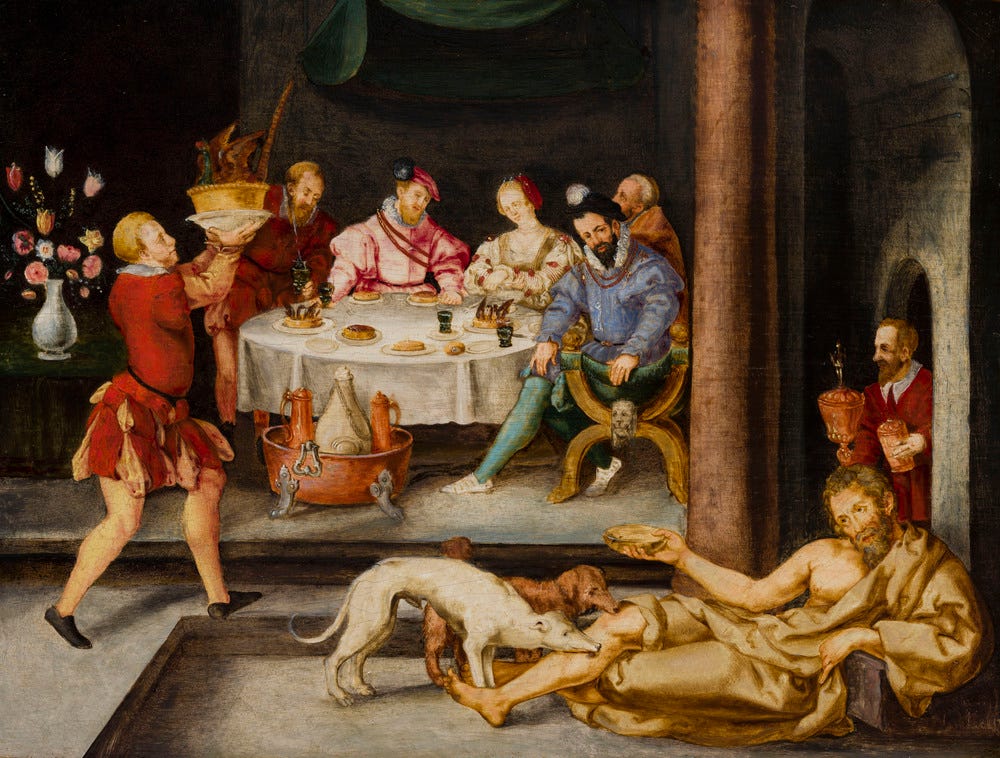
From an open window comes the sounds of clinking glasses, the rise of laughter, the hum of people comfortable with themselves and the world they’ve built. Inside, Dives is hosting one of his regular banquets. The table is long, the wine excellent, the servants attentive. His guests — landowners, merchants, men of status — are deep in discussion about the boundaries of their social circle. Who should be included next month? Who has fallen out of favour? What standards must be upheld?
They are privileged, and whatever their individual views, they share an unconscious pride in the world they inhabit. They speak passionately about fairness, but only as it pertains to their own set — how to maintain cohesion, how to broaden their social circle, how to curate the right mix of people. Their debates can even become intense, as moral debates often do. Yet none of these discussions ever turn outward. Their entire imaginative world is the dining room. For them, the world represented by their banquet is the world—or, at least, as it ought to be.
Meanwhile, outside the gate lies Lazarus.
Each guest stepped past him to enter the house. They all saw him — one can’t not see a starving man lying on the ground being licked by mangy dogs — but they didn’t register him. He’s not part of their mental landscape. He belongs to a different moral universe, one that their reasoning simply doesn’t touch. Their debates feel important, refined, conscientious, even ethical. But every question they ask is about themselves.
To be fair, they’re not monsters. If you stopped them individually and pointed to Lazarus, they would express sympathy. On some nights, a servant may even be sent out with just enough scraps for Dives and his friends to feel charitable. Throwing a few coins, offering leftovers, hosting the occasional charitable banquet: this is how their world manages poverty. It’s doing for, not being with. The fundamental distance remains intact.
And that, of course, is the tragedy. Not only that Dives refuses to help Lazarus, but that he and his companions can spend an entire evening discussing what they take to be important moral questions while ignoring — or half-heartedly appeasing — the suffering they literally step over.
This is where the parable presses too close for comfort.
Much of the moral discussion within Western Christianity now resembles Dives’s dinner conversation. We expend vast energy deciding whom to include, whom to welcome, whom to recognise within our ecclesial life. Many of these conversations are necessary and just. But they’re still discussions about our banquet — our internal life, our social dynamics, our community’s self-understanding. And we’re so absorbed by them that we can walk past Lazarus every day without ever truly seeing him.
And like Dives’s guests, we often pride ourselves on our occasional gestures toward those outside our gates. We give money, volunteer, support charities, run food banks — all good things, necessary things. But they rarely require us to change how we live. They don’t demand solidarity. We’re happy to send scraps through the door; we’re less eager to question why Lazarus is still lying there.
Rowan Williams puts the matter starkly. He writes:
“I don’t believe inclusion is a value in itself….We don’t say ‘Come in and we ask no questions’. I do believe conversion means conversion of habits, behaviours, ideas, emotions. The boundaries are determined by what it means to be loyal to Jesus Christ.”
To recognise the neighbour, he insists, is to recognise the one who has a claim on me — not only to offer polite hospitality, but to allow my life to be disrupted and reformed by their need. That neighbour isn’t simply the person I wish to include in the warm glow of my moral sensibilities; it’s the one whose claim disturbs my habits, complicates my comfort, and demands a limit to behaviour shaped by privilege. The Christian life isn’t about the creation of a comfortable enclave but the steady pressure of what is not ourselves.
This is where our current moral priorities reveal their limits. Justice by expansion — widening the circle, enlarging the guest list — is an essential part of the Christian story. It’s hard to argue with the trajectory of the New Testament, in which Gentiles, women, slaves, foreigners, social outcasts and others long oppressed in the ancient world were welcomed in. Inclusion is a Gospel imperative.
Yet the Gospel also calls for something harder, something far less fashionable in the contemporary West: justice by renunciation, by solidarity, by denial.
Christianity has always asked not only for welcome but for change — a conversion of heart and habits. The earliest Christians understood this well. To become a Christian wasn’t merely to enter a new social circle. It was to renounce a whole way of life steeped in empire, exploitation, cruelty, and disposability. Pagan practices, violent entertainments, arbitrary devaluation of persons: converts were expected to set all of those aside.
They didn’t simply add their name to a roster. They committed to living differently, sparingly, and in solidarity with the poor and defenceless.
By contrast, what do Western churches ask of converts now? Usually very little. We ask them to belong, but not to renounce. We invite them to feel included, but not to change their habits. And we ask even less of ourselves. Our moral imagination begins and ends with the guest list.
But Lazarus at the gate presses a far more demanding question: What must we stop doing if we are to love our neighbour?
For the Church even to begin to answer that question, we must expect to be more than a self-congratulatory moral club. We must recover the moral grammar of limits.
Because it isn’t enough to widen the circle while the conditions of our comfort remain diabolical. It’s not enough to open our arms while keeping our hands full of goods whose production impoverishes our neighbour. It’s not enough to celebrate an inclusive guest list while leaving Lazarus at the gate.
This isn’t a summons to heroic asceticism. It’s a call to basic moral realism — to recognise the uncomfortable truth that as long as we remain steeped in consumption and material excess, in gluttony and greed, none of our efforts at widening inclusion will make us one bit more righteous. Our consumption is never merely personal. Every purchase, upgrade, disposable item, and mass-produced “bargain” is embedded in global networks of extraction, exploitation, environmental damage, labour abuse, and resource depletion. Our lifestyle choices ripple far beyond our living rooms, our neighbourhoods, and even our churches.
To discipline our desires and limit our appetites is to step into solidarity with the Lazaruses of the world — to notice them, to give room for their lives, to give weight to their claim on us.
Of course, such self-limitation sits awkwardly with the dominant ethos of our age. Western culture is built on growth, expansion, personal fulfilment, accumulation, and convenience. Any invitation to self-limitation feels like an affront to our imagined birthright of convenience and growth. But Christianity has never promised harmony with the prevailing mood. The steady pressure of our neighbours is the pressure of the cross — a continual turning outward, a steady dismantling of the self-sufficient life.
If our faith asks us to open the doors, it must also ask us to reshape our own lives. Inclusion and welcome must be joined with transformation and renunciation. Without limits, inclusion risks becoming little more than moral theatre — an exercise in self-congratulation for those already comfortable, with no real cost to their status or habits.
Inclusion without renunciation becomes moral theatre: a way to congratulate ourselves for our broad-mindedness while leaving our lives untouched. The Church can’t be a community that merely throws scraps at Lazarus while demanding nothing of those who feast. It must be a community that forsakes everything that prevents them from joining Lazarus’s company.
The early Christians understood that following Christ would make them conspicuously different — not because they held more enlightened views about belonging, but because they lived differently: more generously, more vulnerably, more attuned to the needs of the stranger.
If Dives had grasped what it meant to love his neighbour, he wouldn’t have focused on the guest list; he would have walked out through his own gate, crouched down on the pavement, and tended Lazarus’s wounds himself. He would have taken his riches, not as a reason to gather more people around the table, but as a responsibility to stand in solidarity with the needy. He would have let the presence of Lazarus shape his life more than the approval of his friends.
Advent invites us into that same reorientation. It begins with the cry of need — the world aching for redemption — and culminates in the astonishing solidarity of God with the poor, fragile, and forgotten. It asks not only whom we will welcome, but what we will relinquish. Whether we will reduce our appetites so others may live. Whether our hope for Christ’s coming includes the willingness to dismantle patterns of comfort that keep Lazarus outside.
The Christian calling — demanding, unsettling, liberating — is not simply to open more doors. It is to cross the threshold, kneel beside the one we have not yet learned to see, and let their need change our feast.