
A World Ruled By Law
How the Christian Moral Vision Shaped Our Rules-Based World Order
The Little Abbey That Defied the Strong
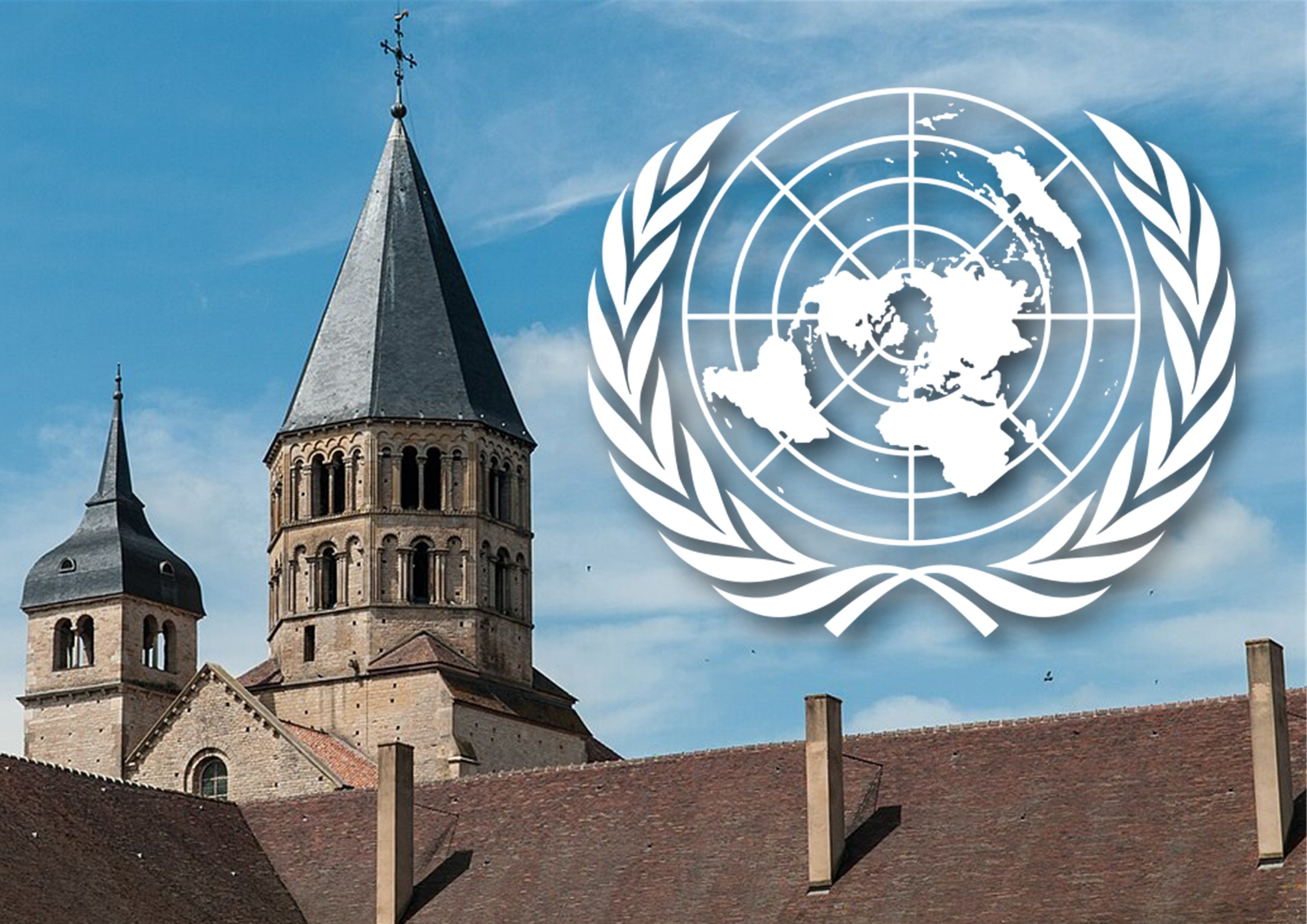
In the autumn of 910, amid the quiet hills of Burgundy, a duke did something unheard of. William the Pious of Aquitaine donated land outright to Saints Peter and Paul, establishing a new monastery under the distant protection of the Pope rather than himself or any local lord or bishop. In an age when churches were often the private fiefdoms of barons and kings, this was radical. Since Papal authority rarely extended beyond central Italy, William’s extraordinary grant effectively made Cluny self-governing.
His aim was surely the salvation of his soul, yet his gift sowed a political legacy few could have imagined. That little monastery at Cluny began with just a handful of monks bound to a stricter Benedictine life. But their devotion to reform soon drew other monasteries under Cluny’s wing, forming Europe’s first truly international network: over three hundred houses answering to the mother abbey rather than local rulers. In its time, Cluny proved that an institution could exist apart from the authority of the nobility and kings yet still wield political influence. Hidden in this medieval experiment is a legacy we’ve nearly forgotten: the idea that institutions can stand beyond local or national power and answer to something higher than national self-interest.
This monastic network became an incubator for a radical idea: that peace could be ordered by rules, not just force. As Cluny’s influence spread across medieval Europe, its monks and allied bishops launched the Peace of God movement. At a time when knights behaved like gang leaders, terrorising peasants and looting churches, these councils compelled them to swear solemn oaths to protect the weak from endless internal warfare. This gave rise to the Truce of God, which declared that violence was forbidden on certain holy days and seasons. The oaths were often broken, and enforcement was patchy at best. But even so, these efforts marked a first step toward morally regulating power and the beginning of long, uneven process of taming war by international norms.
Justice Beyond Borders
At the same time, a legal revolution was stirring in Europe’s libraries and emerging universities. Scholars in cities like Bologna rediscovered the Justinian Code, the vast sixth-century compilation of Roman law, and found in it a blueprint for binding rules that could transcend local custom and brute power. Church jurists combined this Roman legal tradition with centuries of Church decrees and conciliar decisions, creating Canon Law—the first universal legal system since the fall of the Western Empire. The Justinian Code offered a rational legal structure based on the Gospel imperative that power must serve justice. Together, these ideas empowered papal courts to resolve disputes across Europe, including those between rulers—an early forerunner of today’s international courts and treaties.
Out of this tradition grew the medieval revival of the jus gentium—the “law of nations” — the idea that certain principles of justice bound all peoples and rulers. In the sixteenth century, Spanish theologians like Francisco de Vitoria argued that this universal law condemned abuses like unjust war and the exploitation of Indigenous peoples in the Americas. In the seventeenth century, the Dutch jurist Hugo Grotius built on this legacy to lay the foundations of modern international law, insisting that sovereign states must answer to rules higher than their own power.
As the historian Tom Holland shows in Dominion, this whole tradition rested on a claim pagan Rome never made: that emperors and barons would one day stand before the same Judge as the humblest peasant. It was Christianity, not Rome, that taught Europe to expect its kings to justify their power before a moral court—a conviction that still underpins our increasingly fragile belief that our global order should be governed by international rules.
Where Human Dignity Took Root
This insistence that power must answer to a higher law fed directly into something even bigger: the idea that every human being has an inalienable dignity.
Larry Siedentop, in Inventing the Individual, traces this story in detail. The radical Christian claim that each person is made in the image of God and that salvation involves a personal commitment to Christ gradually eroded the ancient world’s assumptions about family, status, and inherited rank. It planted the conviction that the individual has worth simply by being human, whatever his or her birth, rank, or nationality.
To ground this claim, medieval theologians refined the idea of natural law: the belief that moral truths are woven into creation itself, accessible to every rational person. Canon lawyers like Gratian systematised this into a body of rights and duties that applied to Christians across Europe, regardless of local custom. This universal framework shaped later Scholastic thinkers like Thomas Aquinas, who argued that natural law bound all rulers and peoples.
Centuries later, Enlightenment philosophers such as John Locke drew deeply on this medieval legacy—though often without acknowledging it—to argue that certain rights belong to all humans by nature, not by the grant of any ruler or State. This conviction underpins the modern idea of universal human rights, which finds its most eloquent expression in the American Declaration of Independence: “We hold these truths to be self-evident, that all men are created equal, that they are endowed by their Creator with certain unalienable Rights, that among these are Life, Liberty and the pursuit of Happiness.”
Fast forward to the 20th century: after two world wars, leaders gathered to write the Universal Declaration of Human Rights. Its language might be secular and its signatories diverse, but its underlying convictions are rooted in old Christian and natural law instincts: that there is a dignity which no government bestows and no tyrant can annul.
One of the Declaration’s key intellectual architects was Jacques Maritain, a French Catholic philosopher who spent the war years in exile in Canada where he helped to rescue European academics, including Jews. After the war, he worked through UNESCO to help build consensus for a global rights framework. Maritain argued that the world’s nations could agree on human rights in practice, even if they differed on their philosophical foundations. He insisted that many of the core ideas — the equal worth of every person and the conviction that rights are inherent, not granted by the state — drew from centuries of Christian moral thought shaped by the natural law tradition.
Maritain acknowledged that the post-war agreement was fragile—a practical convergence rather than a shared creed—but he believed it could endure because the truths of natural law are accessible to all through reason and conscience. As Tom Holland writes in Dominion, these “secular” rights are not a betrayal of Christianity but one of its greatest gifts to the modern world.
The Gift We Might Squander
Out of the rubble of two world wars, the world’s nations tried to build something new: a world in which peace could be upheld not only by power, but by law. The international order that emerged—through the United Nations Charter, international courts, development agencies, and human rights conventions—was fragile and flawed, but also radical. In the shadow of the Cold War and the nuclear threat, it offered a vision in which brute force wouldn’t get the final word.
Many of those who shaped this order were not naïve idealists but devout Christians who knew the horrors of war and placed their hope in something higher. Robert Schuman, the devout Catholic statesman and father of the European Union, envisioned a Europe so interwoven by law and trade that war would become unthinkable. Konrad Adenauer in Germany and Alcide De Gasperi in Italy built their post-war democracies on Christian principles of forgiveness and reconciliation. Eleanor Roosevelt, the driving force behind the Universal Declaration of Human Rights, believed human dignity was not granted by governments but recognised by them. Charles Malik, the Lebanese Christian philosopher who helped to draft the Universal Declaration on Human Rights, argued that human rights were not a secular invention but an outgrowth of the Christian vision of the person made in God’s image. Dag Hammarskjöld, the Swedish UN Secretary-General, treated diplomacy not as gamesmanship but as moral vocation.
In their faith and their statecraft, we glimpse a truth now too often forgotten: that the international order, for all its many imperfections, was at its best one of Christianity’s greatest gifts to a devastated world—an attempt to place moral limits on power. Indeed, this new world order often found support from Churches and religious organisations, not least the Vatican, Lambeth Conferences, and the World Council of Churches.
Today, that legacy is being dismantled from within rather than by foreign enemies. In recent years, major powers have withdrawn from international agreements, defunded global institutions, and undermined courts meant to hold nations accountable. The United States has slashed aid programmes once seen as moral duties: tools for defending democracy, alleviating poverty, and promoting peace. Increasingly, multilateral institutions like the UN are dismissed as threats to sovereignty, rather than supported as safeguards of order.
Worse still, a rising movement cloaked in Christian language has embraced a gospel of grievance and brute strength. Draped in flags and fuelled by resentments, Christian nationalists seeks to defend the faith by applauding leaders who bend truth, break treaties, and mock the very idea of moral restraint. In the name of Christianity, it aims to destroy a global order rooted in the Christian moral vision.
That’s a bitter irony. The same faith that once told emperors they weren’t gods now risks being weaponised to crown strongmen as saviours. This isn’t the legacy of Cluny, or the Peace of God, or the patient revolution that helped turn feudal lords into citizens. It’s the jungle, dressed for church.
Tom Holland reminds us that Christianity’s scandal wasn’t in making people nice but in binding the mighty with moral chains. Larry Siedentop shows how the Church’s long, patient defence of the individual gave the West its most dangerous idea: that dignity is universal, and no ruler has the right to strip it away. We risk losing that legacy if we trade a rules-based order for unfettered national power.
Now more than ever, we need the moral vision that once told knights to spare peasants, that dared to say kings could be wrong, and that inspired Schuman, Roosevelt, and Malik to build something nobler from the ruins of war. If that vision is truly part of our Christian inheritance, then defending it isn’t not optional; it’s a sacred duty.
The strong will always wield power. That’s just a fact of our fallen world. The question is whether we still demand that the powerful answer to something higher—and bind them to it.
Wonderful reflection.